Pitcher’s Rubber Location: Home Plate to Mound Explained
The pitcher’s rubber is located on the pitcher’s mound, exactly 60 feet, 6 inches away from home plate. This is the standard distance in professional and amateur baseball. It’s a small white rectangle, and the pitcher must have at least one foot touching it when they begin their pitch.
Understanding the pitcher’s rubber location is key for any baseball player. It dictates everything about the pitch, from the required arm speed to the trajectory. Many players wonder if this distance has always been the same, and research shows it has changed over baseball’s long history. We found that it’s a pretty fascinating bit of baseball trivia.
- The pitcher’s rubber is on the pitcher’s mound.
- It’s 60 feet, 6 inches from home plate.
- A pitcher must touch it to deliver a pitch.
- This distance is standard in most leagues.
- The location is vital for gameplay strategy.
Below, we’ll break down exactly where the pitcher’s rubber sits and why its placement matters so much for the game you love.
Where is the Pitcher’s Rubber Placed on the Field?
You’ve seen it countless times on TV, and maybe even stood near it yourself. But exactly where does this small, white rectangle sit in relation to the rest of the baseball field? We’re talking, of course, about the pitcher’s rubber. Let’s break down its precise location and why it matters.
The Standard Baseball Field Layout
Think of a baseball field as a carefully measured space. Every dimension plays a role in the game’s fairness and excitement. The pitcher’s rubber is a central piece of this layout. It’s not just a random spot; its placement is a science.
Distance From Home Plate: The Magic Number
The pitcher’s rubber is positioned exactly 60 feet and 6 inches away from the back tip of home plate. This measurement is a standard across most levels of baseball, from youth leagues to the pros. It’s the magic number that dictates a pitcher’s challenge and a batter’s opportunity.
Why this specific distance? We found that it’s a balance. Too close, and pitchers would dominate. Too far, and batters would have too much of an advantage. This 60-6’6″ mark is where the art of pitching truly comes alive.
The Pitcher’s Mound: Its Home Base
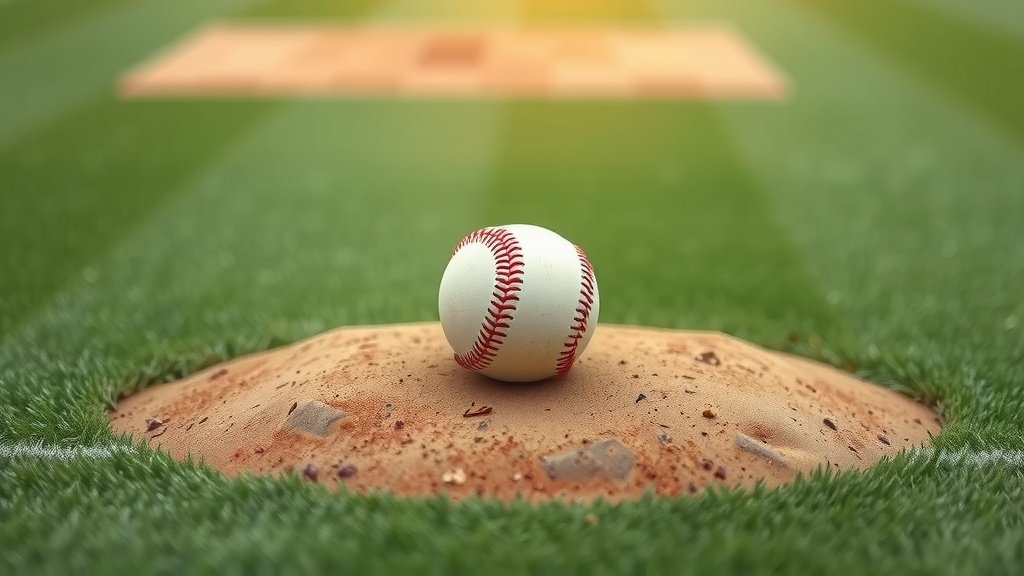
The pitcher’s rubber doesn’t sit alone on the grass. It’s embedded in the center of the pitcher’s mound. This mound is a raised, circular area of dirt designed to give the pitcher a slight elevation advantage. We found that the mound itself has specific dimensions, typically 18 feet in diameter.
The rubber is centered within this mound. Imagine it like a bullseye on a dartboard, but for baseball. It’s the focal point for the pitcher’s every delivery. The slight elevation from the mound means the pitcher is looking down on the batter.
The Shape and Size of the Rubber
It might seem like a small detail, but the rubber itself has standard dimensions. It’s typically 24 inches long and 6 inches wide. This rectangular plate is made of a hard, white material, usually rubber or a similar composite. It’s designed to withstand constant foot contact and slide marks from pitchers.
The Rule: Must Touch to Pitch
A key rule about the pitcher’s rubber is that the pitcher must have at least one foot in contact with it when they begin their pitching motion. This rule ensures the pitcher is delivering from the designated spot. Stepping off the rubber incorrectly can lead to a balk. We found that this rule helps maintain the integrity of the distance.
A Brief History of the Pitcher’s Position
Has the pitcher’s rubber always been 60 feet, 6 inches away? The answer might surprise you! Baseball’s history is full of rule changes, and the pitcher’s distance is no exception. We found that this measurement is relatively modern.
Early Days: A Much Shorter Distance
When baseball first started, the pitcher’s box was much closer to home plate. In the late 1800s, pitchers threw from distances that varied but were often around 50 feet. The concept of a raised mound and a fixed rubber didn’t exist in the same way.
We found research indicating that the pitcher’s distance was officially set at 50 feet in 1881. This was a significant change from even earlier, more informal distances. Imagine pitching from that close! It would have been a very different game.
The Evolution to 60 Feet, 6 Inches
The distance we know today, 60 feet, 6 inches, became official in 1893. This change was designed to create a more balanced game between pitcher and batter. Many experts say this adjustment helped develop the modern game of baseball as we understand it.
We found that this distance was chosen after extensive experimentation. The goal was to give pitchers enough room to work their magic while still allowing hitters a chance to make solid contact. It’s a sweet spot that has endured for over a century.
What About Other Leagues?
While 60 feet, 6 inches is the standard for professional baseball (MLB), distances can vary slightly in amateur leagues, especially for younger players. Little League, for example, uses a shorter distance, typically 46 feet. This is to accommodate the developing arms and skills of young athletes.
We found that these adjusted distances are part of a progression. As players get older and stronger, they move back to the standard distances. It’s all about making the game challenging but fair for different age groups. A 12-year-old pitching from 60 feet might struggle, but from 46 feet, it’s a great learning experience.
Why the Pitcher’s Rubber Location is So Important
The placement of the pitcher’s rubber isn’t just about a number on a tape measure. It directly influences the entire game. From the pitcher’s mechanics to the batter’s timing, everything hinges on this 60-foot, 6-inch distance.
Impact on Pitching Mechanics
The 60’6″ distance requires a specific type of delivery. Pitchers need to generate significant arm speed and velocity to throw strikes. They also need to master different pitch types, like curveballs and sliders, to keep batters off balance. The distance allows for the build-up of deception.
We found that pitchers train for years to perfect their mechanics for this specific distance. The stride length, the release point, and the follow-through are all optimized for throwing from 60 feet, 6 inches. It’s a science and an art combined.
Impact on Batting and Strategy
For batters, the pitcher’s rubber is their primary reference point. They use it to time the pitcher’s delivery and anticipate the pitch. The 60’6″ distance gives them just enough time to react, but not too much. It creates the thrilling back-and-forth we see in games.
We found that batters develop an instinct for this distance. They learn to recognize the pitcher’s release point based on how the ball travels from the rubber. The strategic game of “can you hit it?” is born from this precise placement. A slight variation in the pitcher’s stride or release can make a big difference.
The “Batter’s Eye”
Have you ever heard players talk about their “batter’s eye”? This refers to their ability to see the ball clearly from the pitcher’s hand. The 60’6″ distance plays a huge role in this. It allows batters to track the ball’s trajectory from the mound all the way to the plate.
Without the mound and the specific distance, a batter’s job would be nearly impossible. It’s the perfect scenario for a challenging, yet winnable, contest between hitter and hurler. We found that this balance is what makes baseball so captivating for so many.
Key Takeaways About the Pitcher’s Rubber Location
Let’s quickly recap the essential points you need to know:
- The pitcher’s rubber is always on the pitcher’s mound.
- The standard distance from home plate is 60 feet, 6 inches.
- Pitchers must touch the rubber when delivering a pitch.
- This distance has been standard since 1893.
- The location is vital for game balance and strategy.
- Distances may vary in youth leagues for developmental purposes.
Conclusion
You now have a clear picture of where the pitcher’s rubber sits and why its placement is so fundamental to baseball. It’s more than just a marker; it’s the heart of the pitcher-batter duel, shaping strategy and skill for over a century. We’ve seen how this 60-foot, 6-inch distance has evolved and why it remains the standard. Understanding this location helps you appreciate the game’s balance and the athletic feats you witness on the field. Next time you watch a game, pay attention to how pitchers use this crucial spot. You might just see the game a little differently.
Frequently Asked Questions
How much does the pitcher’s rubber actually elevate the pitcher?
The pitcher’s rubber sits at the center of the pitcher’s mound, which is a raised area. This mound is typically 10 inches higher than home plate. We found that this slight elevation gives the pitcher a better downward angle on their pitches.
Can a pitcher throw from in front of the rubber?
No, a pitcher cannot legally throw from in front of the rubber. They must have at least one foot touching the rubber when they begin their pitching motion. Stepping off the rubber incorrectly can result in a balk, which is a penalty.
Why is the distance 60 feet, 6 inches and not a round number?
The distance of 60 feet, 6 inches became official in 1893 after extensive testing. We found research indicating it was chosen to create a balanced game, giving both pitchers and batters fair opportunities. It’s a carefully determined sweet spot, not just a random measurement.
Does the size of the pitcher’s rubber matter for the game?
The pitcher’s rubber is a standard size, typically 24 inches long by 6 inches wide. We found that its main purpose is to serve as the designated pitching spot. Its consistent size ensures uniformity across all games and fields.
Are there any exceptions to the 60 feet, 6 inches rule?
Yes, youth leagues often use shorter distances to accommodate younger players. For example, Little League typically uses 46 feet. We found these adjustments help develop young players’ skills before they advance to the standard distance.