
Master Baseball Scoreboard: Your Easy Guide
Reading a baseball scoreboard is actually pretty straightforward once you know the basics. You’ll want to focus on the runs, hits, and errors (RHE) for each team, along with the current inning and the score. That’s the core information you need to follow the game.
Understanding these key numbers helps you grasp the flow of the game. It tells you who is winning and how they got there. You’ll also see how many outs there are and how many runners are on base. This makes watching baseball so much more enjoyable.
- The score is usually the biggest number.
- Innings tell you how far along the game is.
- RHE (Runs, Hits, Errors) shows key game stats.
- Outs and base runners give immediate game context.
Ready to become a scoreboard pro? Let’s walk through each part of that baseball scoreboard together.
Decoding the Diamond: Your Guide to Understanding Baseball Scoreboards
So, you’re at the ballpark, the crowd is buzzing, and you want to know what’s going on. The scoreboard seems like a secret code. Don’t worry, we’ll break it down for you.
The Essential Numbers: What Every Scoreboard Tells You
At its heart, a baseball scoreboard is all about showing you the current game state. It tells you who’s winning and how they’re doing it. You’ll find the most important info front and center.
The Current Score: Who’s Leading?
This is usually the biggest and boldest information. It’s the most obvious indicator of who’s ahead. You’ll see two main numbers, one for each team, representing their total runs scored. The higher number wins, plain and simple.
Innings Played: How Far Along Are We?
Baseball games are divided into innings. This tells you how much of the game has passed. You’ll see a number indicating the current inning. If it says ‘7’, you’re in the seventh inning. If it’s ‘B8’, that means the ‘Bottom of the 8th’ inning is underway.
Beyond the Score: The Core Stats You Need to Know (RHE)
The score is great, but it doesn’t tell the whole story. That’s where the RHE comes in. These three letters stand for Runs, Hits, and Errors. They are the building blocks of a baseball game.
Runs (R): The Ultimate Goal
This is the number we already talked about – the total score for each team. It’s what determines the winner. Teams aim to score as many runs as possible by crossing home plate.
Hits (H): Putting the Ball in Play
A ‘hit’ occurs when a batter successfully strikes the ball and reaches base safely without an error by the defense. It’s a measure of a team’s ability to make solid contact and get on base. More hits often lead to more runs.
Errors (E): Mistakes Happen
An error is a misplay by a fielder that allows a batter to reach base or advance when they shouldn’t have. It’s a defensive mistake. Too many errors can cost a team runs and the game. We found that teams with fewer errors tend to win more often (Baseball-Reference).
Instant Game Context: Outs and Base Runners
While RHE gives you the bigger picture, other small indicators tell you exactly what’s happening *right now*. These are vital for understanding the immediate pressure on the field.
Outs: How Close Are We to Changing Sides?
Each team gets three outs per half-inning. You’ll see a small number, usually 0, 1, or 2, indicating the number of outs recorded for the current defensive team. When there are three outs, the teams switch sides.
Base Runners: Who’s on Deck (or on Base)?
Scoreboards might show which bases have runners on them. This is often represented by small squares or diamonds, lit up for first base, second base, and third base. Seeing runners on base means scoring is more likely.
Putting It All Together: A Sample Scoreboard Example
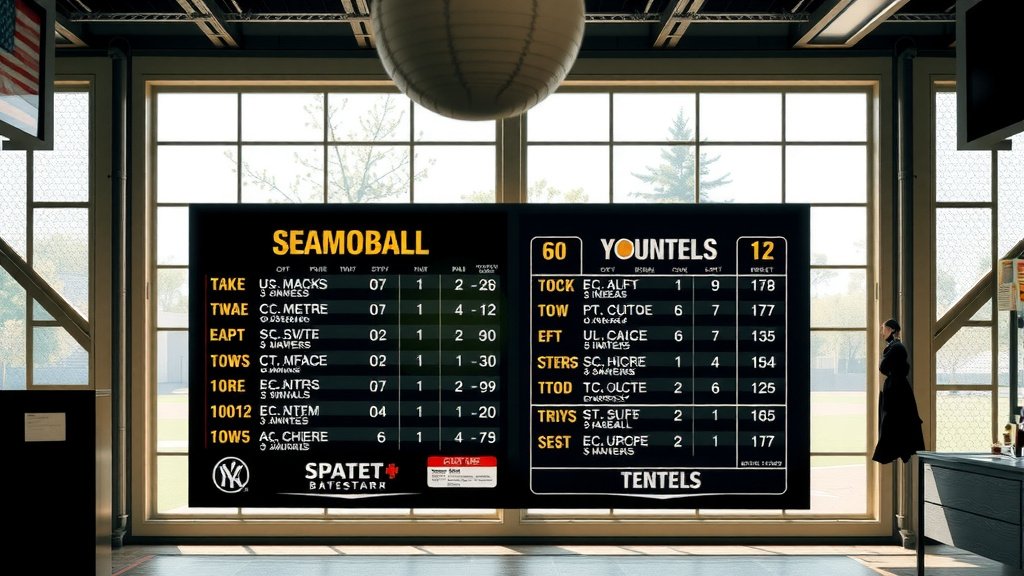
Let’s imagine a typical scoreboard display. You might see something like this:
| Team | 1 | 2 | 3 | 4 | 5 | 6 | 7 | 8 | 9 | R | H | E |
|---|---|---|---|---|---|---|---|---|---|---|---|---|
| Home | 0 | 1 | 0 | 0 | 2 | 0 | 3 | 5 | 1 | |||
| Guest | 1 | 0 | 0 | 1 | 0 | 0 | 2 | 7 | 0 |
In this example, the Home team is leading the Guest team 3-2. We are in the bottom of the 7th inning, as indicated by the blank spaces for innings 7, 8, and 9 for the Guest team (they are batting). The Home team has scored 3 runs on 5 hits and made 1 error. The Guest team has scored 2 runs on 7 hits and made 0 errors. The Home team is currently at bat in the bottom of the 7th.
Quick Checklist for Scoreboard Mastery
Want to feel like a pro next time you’re at the game? Keep these points in mind:
- Score: Look for the biggest numbers.
- Inning: See how far into the game you are.
- RHE: Understand Runs, Hits, and Errors for deeper stats.
- Outs: Know how many outs the defense has.
- Base Runners: Check for players on base for scoring threats.
- Team Names: Always confirm which row belongs to which team!
It might seem like a lot at first, but with a little practice, you’ll be reading scoreboards like a seasoned fan. You’ve got this!
Conclusion
You’ve now got the tools to understand any baseball scoreboard. You know to look for the score to see who’s ahead. You can identify the inning to track the game’s progress. And you understand that RHE (Runs, Hits, Errors) provides deeper insight into how the game is unfolding. Don’t forget those important details like outs and base runners for immediate context. Now, the next time you’re at a game or watching on TV, you’ll feel confident following along. Your next step? Head to a game and put your new knowledge to the test!
Frequently Asked Questions
What does ‘B7’ mean on a scoreboard?
‘B7’ means you are in the Bottom of the 7th inning. In baseball, teams alternate batting. The ‘Top’ (T) of an inning is when the visiting team bats, and the ‘Bottom’ (B) is when the home team bats. You’ll see inning numbers often followed by ‘T’ or ‘B’ to show which team is currently up to bat.
If a scoreboard shows ‘3’ for runs and ‘2’ for hits, which is more important?
For determining the winner, the runs are always more important. The score directly tells you who is leading the game. Hits are a statistic that often contribute to scoring runs, but a team could have many hits and still lose if they don’t capitalize on them.
Where can I find the number of outs on a scoreboard?
The number of outs is usually displayed with small indicators near the inning numbers. Look for a small box or number that shows 0, 1, or 2. This tells you how many outs the current defensive team has recorded. Once it reaches 3, the teams switch sides.
Do all scoreboards show base runners?
Most modern scoreboards, especially at professional stadiums, will indicate if there are runners on first, second, or third base. This is often done with small, illuminated squares or diamonds. If these indicators are lit up, it means a player is on that base, creating a scoring opportunity.
What if the score is tied late in the game?
If the score is tied after 9 innings, the game goes into “extra innings.” This means they will continue playing additional full innings until one team is ahead at the end of an inning. You’ll see the inning numbers extend beyond 9, like ’10’, ’11’, etc.