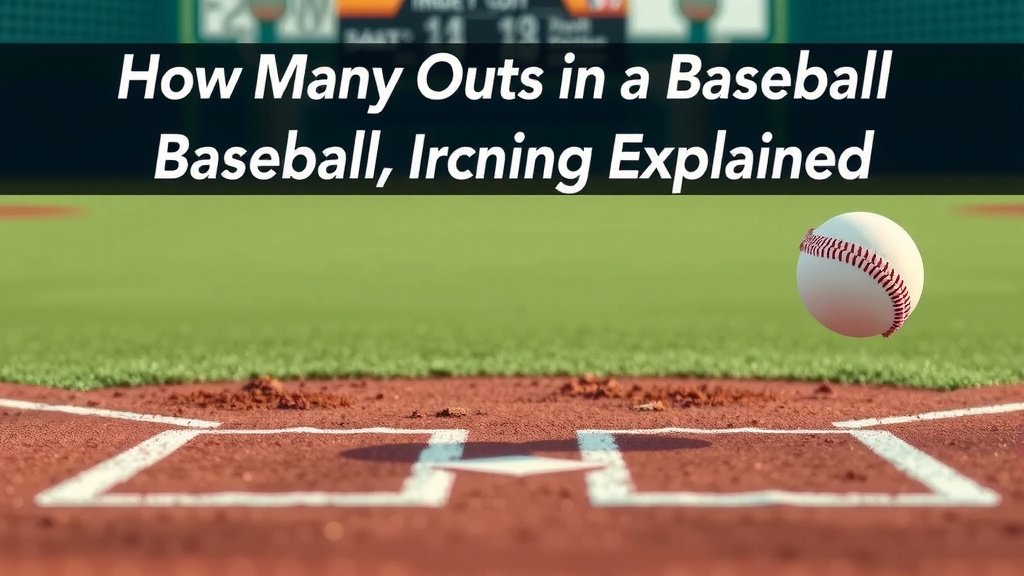
How Many Outs in a Baseball Inning Explained
There are exactly three outs in a baseball inning. This is the rule that governs how many times a team gets a chance to bat. So, your team gets three outs, and then it’s time to switch sides on the field. It’s a fundamental part of the game you can’t miss!
Understanding outs is key to following baseball. When a team records three outs against the offense, the inning ends. This means players will swap positions, and the teams will switch batting and fielding roles. Many fans find this rhythm of the game fascinating.
- Each baseball inning has three outs.
- Three outs signal the end of a team’s turn at bat.
- This rule applies to both the American and National Leagues.
- It’s a core concept for understanding the game’s flow.
Let’s break down exactly what constitutes an out and how it works within an inning so you never miss a beat.
“`htmlUnderstanding the Baseball Inning: A Breakdown of Outs
You’re watching a baseball game, and you hear the announcer say, “That’s three outs!” What does that really mean for the game? Simply put, it means the team currently in the field has successfully retired three batters from the opposing team. Once three outs are recorded, the teams swap roles: the offense becomes the defense, and the defense becomes the offense. This fundamental rule dictates the rhythm of the game and keeps things fair and balanced.
Think of it like this: each team gets a limited number of chances to score when they’re up at bat. Three outs is the magic number that ends their turn. We’ll dig into what actually counts as an out and how it all plays out on the diamond.
What Constitutes an Out? The Different Ways to Get Retired
So, how does a player get “out” and send their team closer to switching sides? Baseball has several ways this can happen. Most commonly, it’s by a fielder catching a batted ball before it hits the ground. But there are many other scenarios, too. Understanding these is key to appreciating the strategy involved in every play.
The Strikeout: Three Strikes and You’re Out!
This is probably the most familiar type of out. A batter accumulates strikes during their at-bat. If they get three strikes, they’re out. A strike can be called if the batter swings at a pitch and misses. It’s also a strike if the batter doesn’t swing at a pitch that the umpire judges to be in the “strike zone.” The strike zone is an imaginary box over home plate that extends from the batter’s knees to the midpoint of their torso. Sometimes, even a foul ball can count as a strike, though there are rules about when that applies, particularly after two strikes.
The Fly Out: Caught in the Air
This happens when a batter hits the ball into the air, and a fielder catches it before it touches the ground. It doesn’t matter how far the ball is hit or where it lands; if it’s caught cleanly, the batter is out. This is why outfielders often get a lot of action, and infielders are ready to pounce on shorter pop-ups. The sheer skill involved in tracking a fly ball can be amazing to watch.
The Ground Out: Beating the Throw
When a batter hits the ball on the ground, fielders try to scoop it up and throw it to a base before the runner reaches it. If the fielder successfully throws the ball to the base and the ball arrives before the runner, the runner is out. This can happen at first base, second base, third base, or even on a force play where a runner is advancing to the next base.
Force Outs and Tag Outs: The Chase for the Bases
Let’s break these down a bit further, as they are very common. A force out happens when a runner is forced to advance to the next base because the batter becomes a runner. For example, if there’s a runner on first base and the batter hits a ground ball, the runner on first must advance to second. If a fielder with the ball touches second base before the runner gets there, it’s a force out. A tag out, on the other hand, occurs when a fielder touches a runner with the ball (or the glove holding the ball) while the runner is not on a base. This often happens when a runner is trying to advance to a base but the ball gets there before they do, and they try to scramble back to the previous base.
Other Ways to Get Out: A Few More Scenarios
Beyond the most common outs, there are a few other ways a player can be retired:
- Batter Interference: If the batter interferes with the catcher’s ability to make a play, they can be called out.
- Runner Interference: If a runner interferes with a fielder trying to make a play on a batted ball, the runner is out.
- Leaving a Base Early: If a runner leaves their base before a fly ball is caught, they can be called out.
- Passing a Runner: A runner cannot pass another runner on the basepaths. If they do, the runner who did the passing is out.
- Running Out of the Baseline: In certain situations, a runner can be called out if they deviate too far from the direct path to the next base to avoid a tag.
- Batter Out of the Box: If a batter steps completely out of the batter’s box while hitting the ball and it results in an unfair advantage, they can be called out.
The Structure of an Inning: Top and Bottom Halves
An inning isn’t just a free-for-all. It’s divided into two halves. The first half is called the “top” of the inning, and the second half is the “bottom.” During the top of the inning, the visiting team bats, and the home team fields. Once the visiting team makes three outs, the inning is over. Then, the teams switch places. The home team comes up to bat (the bottom of the inning), and the visiting team goes out to the field.
Top of the Inning: Visiting Team at Bat
In the top of the inning, the visiting team’s batters take turns trying to hit the ball and get on base. The home team’s pitchers and fielders work to record three outs. This is where you see the initial offensive pressure applied by the team that is playing away from their home stadium.
Bottom of the Inning: Home Team Responds
After the visiting team’s turn is complete, the home team gets its chance. This is the bottom of the inning. They send their batters to the plate, and the visiting team now takes its positions in the field to try and get three outs. The home team always bats last in each inning, which can be a strategic advantage.
How Many Innings in a Standard Baseball Game?
A standard professional baseball game, like those played in Major League Baseball (MLB), consists of nine innings. However, this number can change. If the game is tied after nine innings, extra innings are played until one team has a lead at the end of a complete inning. Some amateur leagues, like college baseball or Little League, might play fewer innings, often seven or six.
The Importance of the Ninth Inning
The ninth inning is often the most exciting. It’s the last chance for the home team to bat if they are trailing. If the home team takes the lead in the bottom of the ninth, the game ends immediately. This is known as a “walk-off” win. If the visiting team is leading going into the bottom of the ninth, they still have to record three outs to secure their victory. The tension can be incredibly high during these final moments.

A Table of Common Outs in Baseball
Let’s summarize the most frequent ways a batter or runner can be called out. This can help you quickly identify what’s happening during a game.
| Type of Out | Description | Who is Out? |
|---|---|---|
| Strikeout | Batter accumulates three strikes. | Batter |
| Fly Out | Batted ball caught in the air by a fielder. | Batter |
| Ground Out | Fielder throws the ball to a base before the runner arrives. | Runner (or Batter-Runner) |
| Force Out | Runner forced to advance to the next base is retired at that base. | Runner |
| Tag Out | Fielder touches a runner with the ball while the runner is not on a base. | Runner |
Why Three Outs? The Logic Behind the Rule
You might wonder why baseball settled on exactly three outs per inning. Baseball evolved over time, and rules were tested and refined. The number three seems to provide a good balance. It allows enough opportunities for offenses to score without the game dragging on too long. It also gives defenses a reasonable chance to prevent runs. Many baseball historians suggest that this number was found to create the most engaging gameplay through experimentation.
Ensuring a Fair Contest
Having a fixed number of outs ensures that both teams get a comparable number of offensive chances over the course of a game. Imagine if innings could go on indefinitely; games could become extremely unbalanced. Three outs creates a predictable structure, allowing fans and players alike to understand the game’s progression. It’s a cornerstone of baseball’s strategic depth.
Quick Checklist for Baseball Outs
Here’s a quick rundown to help you remember the key points about outs in baseball:
- Every inning has a maximum of three outs.
- Once three outs are made, teams switch between batting and fielding.
- Common outs include strikeouts, fly outs, and ground outs.
- Force outs and tag outs are also very frequent.
- The top of the inning is for the visiting team, the bottom for the home team.
- A standard MLB game has nine innings.
Conclusion
You’ve now got a firm grasp on the heart of baseball’s rhythm: the three outs per inning. You know how a batter can be retired through strikeouts, fly outs, ground outs, and other less common ways. You also understand how the top and bottom halves of an inning work, and the standard length of a game. This knowledge lets you follow the strategic ebb and flow of any baseball match. Your next step? Watch a game with this understanding and see how much more you appreciate each play!
Frequently Asked Questions
What happens if a team scores a run after two outs?
If a team scores a run after there are already two outs, that run still counts. The inning doesn’t end until the third out is officially recorded. This means even a single run can be crucial for momentum.
Can an inning have fewer than three outs?
No, a regulation inning in baseball always consists of exactly three outs for the defensive team to record. If an inning ends prematurely for some reason (like weather), it’s usually a called game, not a shorter inning.
How many outs are there in extra innings?
The rules for outs remain the same in extra innings. Each half-inning still requires three outs. Play continues until one team is leading at the end of a complete inning.
Does the number of outs change in different leagues?
The rule of three outs per inning is a universal standard in baseball, from Little League up through Major League Baseball. You won’t find leagues that play with a different number of outs per inning.
What’s the fastest way an inning can end?
The fastest an inning can end is by recording three outs without the batting team ever putting a ball in play. This is known as an “Immaculate Inning” when a pitcher strikes out all three batters on just nine pitches.