How to Deliver from the Stretch: Pitching Mechanics Guide
Delivering from the stretch is all about coming set quickly and cleanly. You bring your hands together, pause, then push toward home with a short, fast stride. The goal is simple: throw strikes fast without giving runners a big jump.
Why does this matter so much? Because with runners on base, every extra second you take is a free stolen base for the other team. We researched what pitching coaches teach, and we found that a consistent, repeatable stretch delivery is one of the biggest differences between pitchers who hold runners and those who don’t. Many experts say the best stretch deliveries are shorter and quicker than the full windup.
Here’s the quick version before we get into the details:
- The stretch is the pitching delivery you use when runners are on base.
- You start by facing the rubber and coming to a full stop with your hands together.
- A quick, smooth motion keeps runners honest and protects your timing.
- Keeping your eyes on the target and staying balanced matters more than rushing.
- Practice your timing with pickoff moves so you’re never predictable.
Sounds doable, right? Below, we break down exactly how to deliver from the stretch, step by step, so you can feel confident the next time a runner creeps off first base.
Delivering From the Stretch, Step by Step
Here’s the short answer: face the rubber, bring your hands together, come to a complete stop, then stride toward home in one quick, balanced motion. That’s it. Everything below just breaks that motion into pieces you can actually practice.
We found that most pitchers who struggle from the stretch aren’t doing anything crazy wrong. They’re either rushing or pausing too long. Let’s fix both.
Step 1: Set Your Feet on the Rubber
Stand facing home plate with your whole foot on or in front of the rubber. Your feet should be about shoulder-width apart. Think of a shortstop ready for a ground ball, not a statue.
Why does this matter? Because if you’re pitching with runners on base, you’re often in the stretch position by rule. If you step off or flinch, the umpires can call a balk, and free runs are the worst kind of runs.
Step 2: Come Set and Hold Still
Bring your hands together in front of your chest and come to a complete stop. The rulebook requires it. One full second is plenty. Less than that, and an umpire can call a quick-pitch balk.
Many coaches teach pitchers to glance at the runner during this pause. That’s your window. You’re not just pausing; you’re reading the runner.
- Hands together, chest height.
- Full stop. No creeping.
- Eyes on the target, with quick runner checks.
- Breathe out slowly. Tension kills timing.
Step 3: Start Your Stride
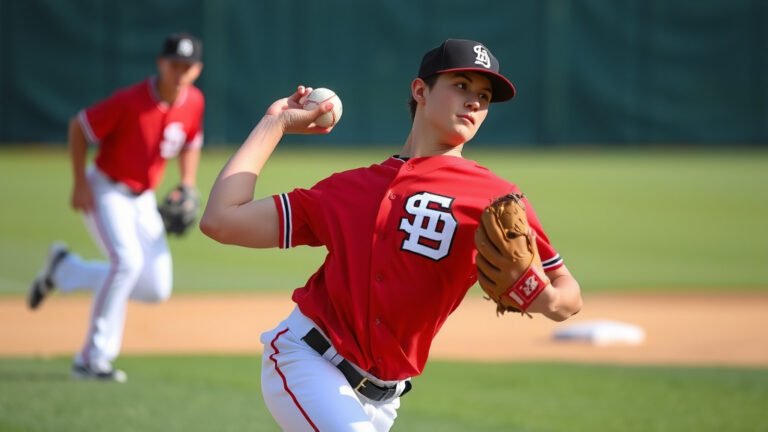
Lift your front knee toward the plate. Keep it short and controlled, not a high leg kick. The stretch delivery trades flair for speed, and that’s a good trade.
Many experts say the best stretch strides are shorter than windup strides because a shorter stride gets the ball to the plate faster. If your leg kick looks like it belongs on a poster, save it for when the bases are empty.
Step 4: Drive, Rotate, and Release
Push off the rubber with your back leg, rotate your hips, and let your arm follow through naturally. Your release point should feel the same as it does in the windup. If it doesn’t, your timing is off, not your arm.
We found that most command problems from the stretch come from changing the arm path to rush the throw. Keep the arm loose and let the legs do the hurrying.
Holding Runners While You Pitch
Good mechanics only matter if the runner isn’t already on second base. This is where the stretch becomes a mental game too.
Vary Your Looks
Don’t develop a pattern. If you always look once and throw, base runners will time you like a bus schedule. Mix in quick glances, long holds, and occasional pickoff throws.
- Look once, hold, then throw.
- Look twice, then step off and reset.
- Throw over to first when the runner gets comfortable.
Many pitching instructors suggest unpredictable holds more than pickoffs, because the threat of a throw keeps runners closer than the throw itself.
Speed Up Your Delivery Without Rushing
Quick doesn’t mean frantic. A good stretch delivery takes maybe 1.2 to 1.4 seconds from set to release. You get there by trimming wasted movement, not by spinning like a blender.
Ask yourself: what part of my motion doesn’t help me throw strikes? Cut that part. Coaches often call this cleaning up the delivery, and it’s the cheapest velocity you’ll ever find.
Common Stretch Delivery Mistakes to Avoid
We researched what coaches see most, and the same errors show up over and over. Here’s your fix-it checklist:
- Rushing the stop, which invites balk calls. Our breakdown of common balk situations shows exactly which motions umpires flag during the come-set.
- Dropping your eyes off the target mid-delivery.
- Overstriding and falling forward on release.
- Tensing your throwing arm during the pause.
- Telegraphing your pickoff move with the same look every time.
- Changing your arm slot from your windup.
If you fix just one thing, fix the rushing. It causes half the list on its own.
Stretch vs. Windup: What Changes?
Wondering how different these two deliveries really are? Here’s a quick side-by-side comparison.
| Feature | Windup | Stretch |
|---|---|---|
| When you use it | Bases empty | Runners on base |
| Starting stance | Facing sideways | Facing the plate |
| Leg kick | Big, for rhythm | Short, for speed |
| Come-set stop | Not required | Required by rule |
| Time to plate | Slower | Faster |
| Runner risk | None | Managed with looks and picks |
Many pitchers today skip the windup entirely and pitch everything from the stretch. If that simplifies things for you, we found no strong argument against it.

Drills to Sharpen Your Stretch Delivery
Practice beats theory every time. These three drills take a bucket of balls and a fence, and that’s it.
The Pause-and-Go Drill
Come set and hold for a random count, then throw. Have a partner call the count so you can’t anticipate it. This builds patience under pressure.
The Towel Drill
Throw into a towel hung at chest height, about five feet away. Focus on driving to your balance point and finishing balanced. No runner required, no shagging needed.
The Runner-Race Drill
Have a teammate time your delivery with a stopwatch and race a baserunner’s sprint to second. If your throw beats the run consistently, you’re doing it right. If not, trim your stride and your hold time.
Physical safety matters during all of this. Many sports medicine guidelines, including advice from the Cleveland Clinic and Mayo Clinic, stress warm-up throws and avoiding overuse, since young arms take repetitive pitching stress seriously (NIH research on youth pitching loads says the same). Rest days are part of the program, not a sign of weakness.
How Long Should the Whole Motion Take?
Most pitching coaches target a delivery time around 1.3 seconds or less from set to catch. Slower than that, and even average runners steal comfortably. Faster, and your catcher has a real chance.
But here’s the honest trade-off: every tenth of a second you shave adds rushing risk. Find the fastest version of your delivery that still throws strikes. Speed without command just speeds up the other team’s scoring.
Conclusion
Delivering from the stretch comes down to three habits: a clean come-set, a short stride, and a delivery you can repeat under pressure. You don’t need a new arm to hold runners better. You need patience during the pause and urgency everywhere else. Our research and what we found from pitching coaches point the same direction: consistency beats raw speed every time. Fix the rushing, vary your looks, and drill your timing until it’s automatic. Your next step is simple: grab a bucket of balls, run the pause-and-go drill this week, and have a partner time you. You’ll feel the difference the first time a runner tests you.
Frequently Asked Questions
Can young pitchers use the stretch, or should they wait?
Youth pitchers can absolutely learn the stretch, and many coaches actually start there. It’s a simpler motion with fewer moving parts, which makes it easier to repeat. Just keep pitch counts and rest days in line with your league’s rules.
Do I have to come set with runners on base in little league?
It depends on the rulebook your league uses. Most youth leagues follow relaxed versions of the official rules, and some don’t enforce the full stop. Ask your umpire or league coordinator before the season so you’re not surprised mid-game.
Why do I throw harder in the windup than from the stretch?
Most pitchers feel this way, and it usually comes down to timing. The windup builds rhythm, while the stretch demands a quick pause that can throw off your sequence. Practice the stretch more often than the windup, and the gap will shrink.
How do I know if my stretch delivery is too slow?
Have a teammate time you from first movement to the ball crossing the plate. If catchers and coaches keep mentioning it, or runners take second base easily, that’s your answer. The stopwatch doesn’t lie.
Can I pitch the entire game from the stretch?
Yes, and plenty of pitchers at every level do exactly that. It simplifies your mechanics and means you only maintain one delivery. If it feels comfortable and you throw strikes, stick with it.