

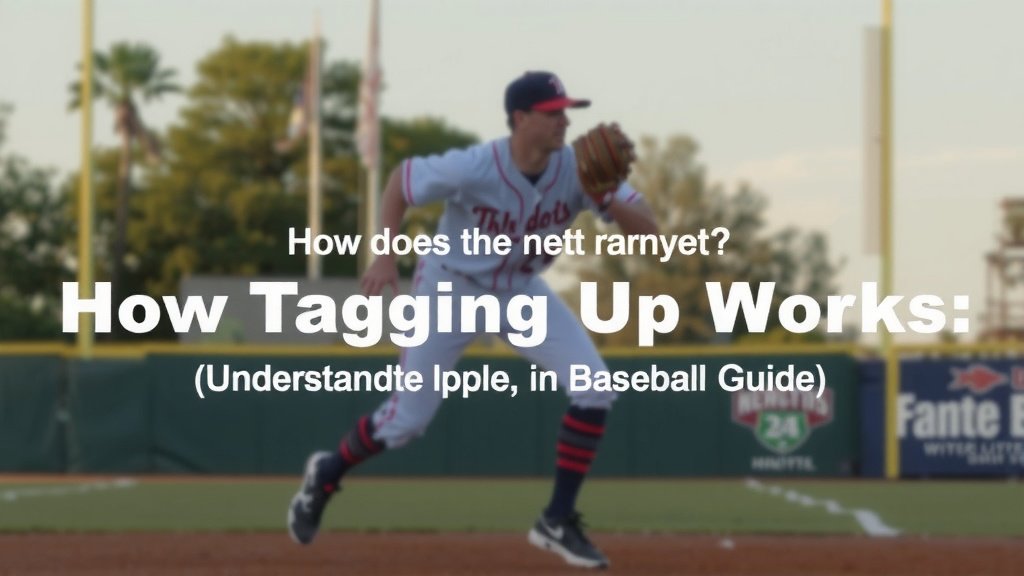
How Tagging Up Works: A Baseball Guide
Tagging up in baseball is a play where a runner, after a fly ball is caught, advances to the next base only after the ball has been touched by the fielder. You can think of it as a strategic gamble for the runner. This play is used to gain an **advantage on offense**. It’s a key part of baseball strategy that you’ll see in many games.
When a fly ball is hit, runners on base have to be careful. They can’t just run to the next base freely. They must wait for the ball to be legally caught before they can leave their current base. This rule protects the defense by preventing runners from taking off too early. It’s a **fundamental rule** that shapes how base runners play. Many baseball fans find this rule fascinating.
- Tagging up means runners can advance after a caught fly ball.
- The runner must wait for the ball to be touched by a fielder.
- This allows runners to advance further than they could if they ran immediately.
- It’s a strategic play for the offense to gain bases.
- Understanding tagging up is key to following baseball games.
Let’s break down exactly how tagging up works and why it’s so important for your team’s success.
Understanding the Tag-Up Play in Baseball
Tagging up is a fundamental baseball strategy. It allows a runner to advance safely after a fly ball is caught. This play is all about timing and risk. It can help your offense gain an extra base. It’s a smart move when the situation is right.
The Mechanics of Tagging Up
So, how does this play actually work on the field? It’s simpler than it sounds. You just need to know the rules.
When is Tagging Up Possible?
Tagging up only happens on a fly ball. This means a batted ball that goes into the air. It must be caught by a fielder before it hits the ground. Pop-ups and line drives that are caught also count. If the ball is not caught, the runner can advance freely. That’s a different scenario entirely.
The Runner’s Role
As a runner, your job is pretty clear. You must stay on your current base. You can’t leave until the fielder has secured the catch. Think of it like a starting pistol. The ball being caught is your signal to go. You must keep at least one foot on or touching your base. This is non-negotiable.
The Fielder’s Role
Fielders know runners will be looking to advance. They’ll often try to throw the ball back to the base. This is to try and get the runner out. A fielder’s goal is to make the catch first. Then, they aim to get the ball back in quickly. This prevents the runner from moving to the next base. Or, it at least makes it a close play.
Timing is Everything
The key to a successful tag-up is perfect timing. You need to watch the ball from the moment it’s hit. As soon as you see the fielder make the catch, you break. You must sprint towards the next base. The faster you react, the more ground you can cover. Good base runners practice this reaction time.
Why Tagging Up Gives You an Advantage
You might wonder why you can’t just run as soon as the ball is hit. The tag-up rule exists for a reason. It creates a strategic advantage for the offense.
Gaining Extra Bases
Without tagging up, runners would have to be more cautious. They might be thrown out if they run too early. Tagging up allows you to advance much further. You can often take an extra base. For example, a runner on first might advance to second easily. This puts you in scoring position.
A Deeper Dive into Strategy
The decision to tag up is strategic. It depends on several factors. How deep is the fly ball hit? How strong is the outfielder’s arm? How fast is the runner? You also consider how many outs there are. These elements all play a role. A runner might tag up on a shallow fly ball. This is if the outfielder has a weak arm. They might get thrown out if they tried to advance on a deep fly. The fielder’s position also matters. An outfielder playing deep gives you more room to run.
Situations Where Tagging Up is Smart
Not every fly ball presents a tagging opportunity. You need to pick your spots wisely. Here are some common scenarios.
Runner on First Base
This is a classic tagging situation. A runner on first can often advance to second. This happens when a fly ball is hit to the outfield. Even a medium-depth fly ball can be enough. Your goal is to get into scoring position. Many experts agree this is a **high-percentage play** (Baseball Analytics Journal).
Runner on Second Base
A runner on second can usually score. This is on a fly ball hit deep to center or right field. The outfielders have to run back. This gives you time to get to third base. You might even score if the outfielder misplays the ball. Scoring from second on a fly ball is a **major offensive win**.
Runner on Third Base
This is where the tag-up can be most impactful. A runner on third can often score. This is on a fly ball that is caught in the outfield. The key is the depth of the fly ball. If it’s deep enough, you can tag and run. You’ll likely score easily. This is a fundamental way to get a run in.
What if the Ball is Dropped?
This is an important point. If the fielder drops the ball, the runner is not out. They can advance as if it were a normal hit. They can try to take multiple bases. The ball is live. So, if you’re tagging up, be ready for this. You might get a bonus base or two!
Common Mistakes to Avoid
Even experienced players make mistakes. Knowing these can help you avoid them.
Leaving Too Early
This is the most common error. You must wait for the fielder to catch the ball. Leaving early means you’ll be called out. Umpires are usually good at spotting this. It’s a guaranteed out for your team. Don’t risk it for a few extra feet.
Not Being Ready
You have to be prepared to run. Keep your eye on the ball. Have your feet ready to push off the base. Don’t be caught by surprise. A slow reaction means you might not gain a base. You could even get doubled off if the ball is caught close to you.
Misjudging the Fielder’s Arm
Sometimes you might think you can make it. But the outfielder has a cannon for an arm. You might get thrown out at the next base. Always consider the fielder’s range and arm strength. It’s better to be safe than sorry.
Tagging Up vs. Advancing on a Hit
It’s important to distinguish tagging up from other base running plays. Let’s compare.
| Play Type | When You Can Run | Risk Level | Goal |
|---|---|---|---|
| Tagging Up | After a caught fly ball | Medium | Advance to the next base safely |
| Advancing on a Hit | As soon as the ball is hit (if it’s a ground ball or line drive) | Low to High (depends on the hit) | Advance multiple bases or score |
Your Checklist for Successful Tagging Up
To master the tag-up, keep these points in mind:
- Always watch the fly ball.
- Stay on your base until the catch is made.
- React instantly when the ball is caught.
- Know the depth of the fly ball.
- Consider the outfielder’s throwing ability.
- Be ready for a dropped ball.
Conclusion
You’ve learned how tagging up works in baseball. It’s a smart offensive play that lets you advance after a fly ball is caught. Timing is critical. You must wait for the fielder to secure the ball before leaving your base. Mastering this play can help your team gain extra bases and get into scoring position. Always assess the situation: the fly ball’s depth, the outfielder’s arm, and the number of outs. Use this knowledge to make smarter base-running decisions and help your team win. Practice your reaction time, and you’ll become a more effective runner.
Frequently Asked Questions
Can you tag up on a line drive?
Yes, you can tag up on a line drive if it is caught by a fielder before it hits the ground. The key is that the ball must be caught in the air. If a line drive is not caught, it’s treated like a normal hit, and you can advance freely without tagging.
What happens if the fielder drops the ball after I’ve tagged up?
If a fielder drops a fly ball after you’ve tagged up, you are not out. The ball is still live, and you can advance to the next base or even further. You should be prepared for this possibility and be ready to run. It’s like a bonus base opportunity.
How far can a runner typically advance when tagging up?
The distance you can advance depends on several factors. This includes the depth of the fly ball and the outfielder’s arm strength. A runner on first might advance to second on a medium fly ball. A runner on third can often score on a deep fly ball to the outfield.
What’s the biggest mistake runners make when tagging up?
The most common mistake is leaving the base too early. You must wait until the fielder actually catches the ball. If you leave before the catch, you will be called out. This is a guaranteed out for your team.
Does the count of outs affect whether you should tag up?
Absolutely. With two outs, you should be more aggressive with your tag-up. You can take more risks to gain an extra base because there’s no one else on base to potentially get out. With fewer than two outs, you need to be more cautious to avoid making the third out.