How to Identify a Curveball Coming Before It Reaches You
You can identify a curveball coming by watching the ball’s release point and spin out of the pitcher’s hand. A curveball usually comes out of a slightly lower release point, looks chunkier in the fingers, and shows a hump on top of the ball as it travels toward you. Most pitchers also tip it off with a subtle change in grip or wrist action.
Here’s the tricky part: by the time you notice it, you’ve got a split second to react. That’s why the best hitters train their eyes to pick up cues before the ball is halfway to the plate. We looked at what hitting coaches and former players actually teach, and the good news is that these cues are things you can practice, whether you’re facing a crafty Little League lefty or a high school ace with a nasty hook.
TL;DR — Quick takeaways:
- Watch the pitcher’s release point — curveballs tend to come out lower than fastballs.
- Look for the telltale red dot or visible spin pattern as the ball leaves the hand.
- Notice a hump or “pop-up” look in the ball’s flight path early on.
- Pay attention to grip and wrist movement during the windup.
- Train your eyes with live batting practice so cues become second nature.
Below, we break down every cue worth knowing, step by step, so you can pick up the curveball earlier and swing with way more confidence. Let’s dig in.
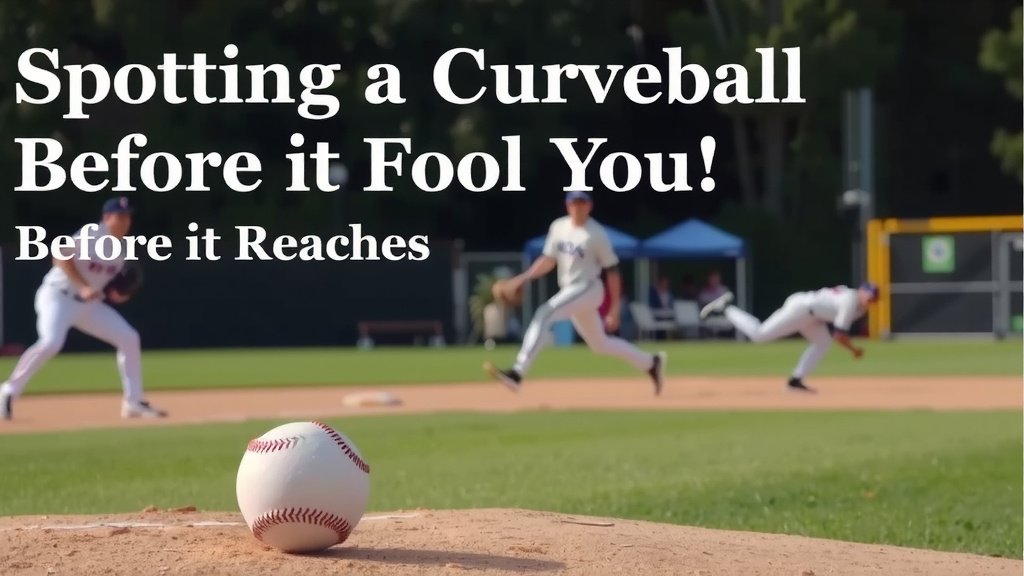
Spotting a Curveball Before It Fool You
The biggest secret about reading off-speed pitches? It starts before the ball is even thrown. Your eyes should be locked on the pitcher’s hand and arm, not the release point itself. We found that most hitting coaches teach the same thing: watch the ball come out of the hand, then trust what you see.
Think of it like spotting a counterfeit bill. You don’t study fakes. You study the real thing so hard that anything off jumps out at you. Same deal here. If you know what a fastball release looks like, a curveball will feel wrong in a helpful way.
Why the Release Point Matters Most
Most curveballs come out of a slightly lower slot than fastballs. The pitcher has to get on top of the ball and pull down through it, so the hand finishes lower and closer to the body. Fastballs, by comparison, usually fly out with the hand a bit higher and more out front.
Dr. Glenn Fleisig and other biomechanics researchers who study pitching motion have noted that different pitches create different wrist and forearm actions. You don’t need a lab to use that info, though. You just need to watch the hand.
What to Look For at Release
- The hand finishes lower and closer to the hip than a fastball.
- Wrist action looks like a turn or twist instead of a clean snap.
- The thumb or fingers seem to “wrap” the ball a beat longer.
- The arm may look like it’s pulling down rather than throwing through.
Catch one or two of these cues and you’ve already bought yourself extra time. That’s huge when the pitch is about to drop off the table.
The Red Dot and Spin Cues
Here’s a fun one. Many hitters swear they see a tiny red dot or blur on a well-spun curveball. That’s the seams spinning together, creating a solid-looking spot. If you see that dot instead of the classic four-seam “pink blur,” your brain should sound the alarm.
Fastball spin looks tight and clean. Curveball spin looks chunkier and looser, almost like the ball is tumbling forward. It takes some reps to see it, but once you do, it’s hard to unsee.
Reading the Ball’s Flight Path
The first half of the ball’s trip tells you a lot. A curveball often looks like it’s rising or popping up out of the pitcher’s hand. That’s an illusion, but it’s a useful one. The ball is actually spinning so it stays up longer before the break kicks in.
So what do you do with that? Simple. If the ball looks like it’s floating up early, expect it to fall late. Stay back, keep your hands inside the ball, and let the pitch come to you.
Fastball vs. Curveball Flight: A Quick Compare
| What You See | Fastball | Curveball |
|---|---|---|
| Early flight path | Straight, boring line | Slight hump or “pop-up” look |
| Spin look | Tight, clean blur | Red dot or chunky tumble |
| Late movement | Little to none | Sharp downward break |
| Release point | Higher, out front | Lower, closer to body |
The Height Trick Hitters Use
Many coaches teach a simple rule: track the bottom of the ball, not the top. On a curveball, the bottom drops out fast. If you’re watching the top, you’ll be fooled every time. Watching the bottom keeps your eyes honest.
We found this tip repeated across hitting programs at nearly every level, from youth travel ball to college camps. It works because your brain judges depth and height from the ball’s lower edge.
Pitcher Tells: Reading the Windup and Grip
Some pitchers are walking hint machines. They grip the ball differently, slow their arm, or change their body language when a curveball is coming. Your job is to spy it out during your at-bat prep, not guess mid-pitch.
Common Tells to Hunt For
- The pitcher checks the grip or re-seats fingers in the glove.
- The leg lift slows down or gets extra careful.
- The arm speed decelerates on off-speed pitches (the classic “baby arm”).
- Shoulders or elbow angle change slightly at hand break.
- Same count, same situation: he threw a curve the last two times.
That last one is sneaky-good. Pitchers are creatures of habit. If a guy loves his hook with two strikes, you can look for it before it arrives.
Why Pitchers Try to Hide the Curveball
Good pitchers work to make every pitch look identical out of the hand. It’s called tunneling, and it’s basically the art of deception. So when a pitcher fails at it — arm slows, grip shows, release drops — that’s your window. Take advantage. He won’t make that mistake twice.
Training Your Eyes to Pick It Up Earlier
You can’t think your way through a 75-mph curveball. It has to be automatic. The good news? Eye tracking and pitch recognition are trainable skills, and you don’t need fancy equipment to start.
Simple Drills That Actually Work
1. Live BP With a Purpose
Ask a coach or teammate to mix curveballs in batting practice — but don’t swing at first. Just call the pitch out loud as it leaves the hand. “Fast.” “Curve.” “Fast.” You’re building the recognition muscle, not the swing.
2. The Two-Ball Flip
A partner flips two different-colored balls at once and calls out a color. You hit or catch only that one. It’s silly, it’s humbling, and it sharpens contrast and spin recognition fast.
3. Soft Toss With Spin
Have a partner toss curveballs from five feet away underhand with clear spin. Watch the rotation. Call out spin direction. Easy reps, big payoff.
A Quick Pre-At-Bat Checklist
Before you step in, run through this. It takes ten seconds and saves you a lot of embarrassed walks back to the dugout.
- Scout the release point from the on-deck circle.
- Watch for grip adjustments in the glove.
- Track the bottom of the ball out of the hand.
- Look for the red dot or chunky spin.
- Note the count and sit on his favorite off-speed spot.
- Trust your first read — hesitation kills.
One more thing worth saying: reaction time matters, and it’s trainable too. Studies indexed by the National Institutes of Health have looked at how elite hitters use early visual cues to buy extra milliseconds. You may never hit like a pro, but you can borrow their playbook: eyes early, decision fast, swing late and smooth.
And hey, if you get fooled a few times while learning? Welcome to the club. Every hitter who ever dug in against a nasty hook has done the knee-buckle dance. The ones who improve are the ones who keep watching, keep drilling, and keep laughing it off on the way back to the bench.
Conclusion
Reading a curveball comes down to catching one early cue and trusting it. Watch for the lower release point, the chunky spin or red dot, and that little hump in the early flight path. If the pitcher tips his grip or slows his arm, even better — that’s a free heads-up.
The hitters who handle off-speed pitches well aren’t born with magic eyes. They’ve just put in reps calling pitches out loud, tracking the bottom of the ball, and learning what a fastball release should look like. Do the same, and the hook stops feeling like a trick.
Your next step: grab a partner this week and run the live BP pitch-calling drill for 15 minutes. Don’t even swing. Just call every pitch as it leaves the hand. Do that a few times and you’ll notice the curveball getting easier to spot — before it drops off the table.
Frequently Asked Questions
Can you really see the spin on a baseball from the batter’s box?
Yes, but it takes practice. Most hitters describe it as a blur pattern rather than a clear image — a tight, clean blur means fastball, while a chunky or dotted look usually means curveball. The more live pitches you see, the faster your brain picks it up.
What should I do if I recognize the curveball too late to lay off it?
Shorten your swing and focus on making contact instead of driving the ball. Keep your weight back and your hands inside the ball. Recognizing it late still beats not recognizing it at all — you might just Spoil the pitch and stay alive.
Do all curveballs break the same way?
Nope. Some are slow loopy benders, while others are harder and tighter like a slurve or knuckle curve. The break direction is similar, but the speed and sharpness vary a lot. That’s why it helps to scout each pitcher individually instead of using one general rule.
Is it better to guess curveball in certain counts?
Sitting on a curveball in predictable counts — like 0-2 or 1-2 — can work, but it leaves you vulnerable if he throws a fastball instead. We found most coaches suggest looking for the spin cue instead of committing to one pitch. React to what you see, not what you fear.
How long does it take to get better at recognizing curveballs?
It depends on how often you see live pitching, but most hitters notice improvement within a few weeks of focused drills. Pitch recognition is a skill like any other — reps matter more than talent. Even 15 minutes of pitch-calling a couple of times a week makes a real difference.