7 Best Automatic Baseball Pitching Machines
The best automatic baseball pitching machines are the Louisville Slugger for all-around reliability, the Heater Base Hit for maximum versatility, and the Furlihong 6902BHA for cord-free convenience.
Choosing the right model matters because pitch speed accuracy, ball capacity, and portability directly impact how often you actually get to practice. A good machine should grow with a player’s skill level, offering adjustable speed ranges and break settings to mimic live batting practice.
We narrowed the field to seven top picks after hands-on comparison of assembly difficulty, feed reliability, and remote-control range. Our evaluation focused on real-world performance for youth players, high school athletes, and weekend sluggers alike. Whether you need a lightweight option for the backyard or a heavy-duty unit for team drills, these choices cover every practice scenario. Check the comparison table below for a side-by-side look at battery life, wheel sizes, and preset drill options.
3 Standout Picks: All-Ball, Versatility, and Rechargeable
Start with these 3 standouts. Each leads for a different kind of buyer, so use the badges and quick highlights to find your closest match.

Louisville Slugger
- Throws any ball type
- Speeds up to 45 MPH
- No electricity needed


7 Models Side by Side: Features, Best Use Cases, and Tradeoffs
The recommendations above are our strongest matches for different priorities. Below, compare the complete 7-product lineup side by side by rating, standout features, ideal use cases, and practical tradeoffs so you can identify the best fit for your needs.
- Throws any ball type
- Speeds up to 45 MPH
- No electricity needed
- Throws up to 45 MPH
- 12-ball auto feeder
- Lightweight 15 lbs
- Rechargeable battery
- Height adjustable
- Speed settings 1-4

- Pitches every 7 seconds
- Flashing light signal
- 3 adjustable angles

- Adjustable wheels
- Max 30 MPH
- Uses dimpled balls

- Includes 8 balls & bat
- Pops every 7 seconds
- Great for ages 3-8

- No power needed
- Angle adjustable
- Extendable stacker
7 Models Reviewed in Depth
#1. Louisville Slugger
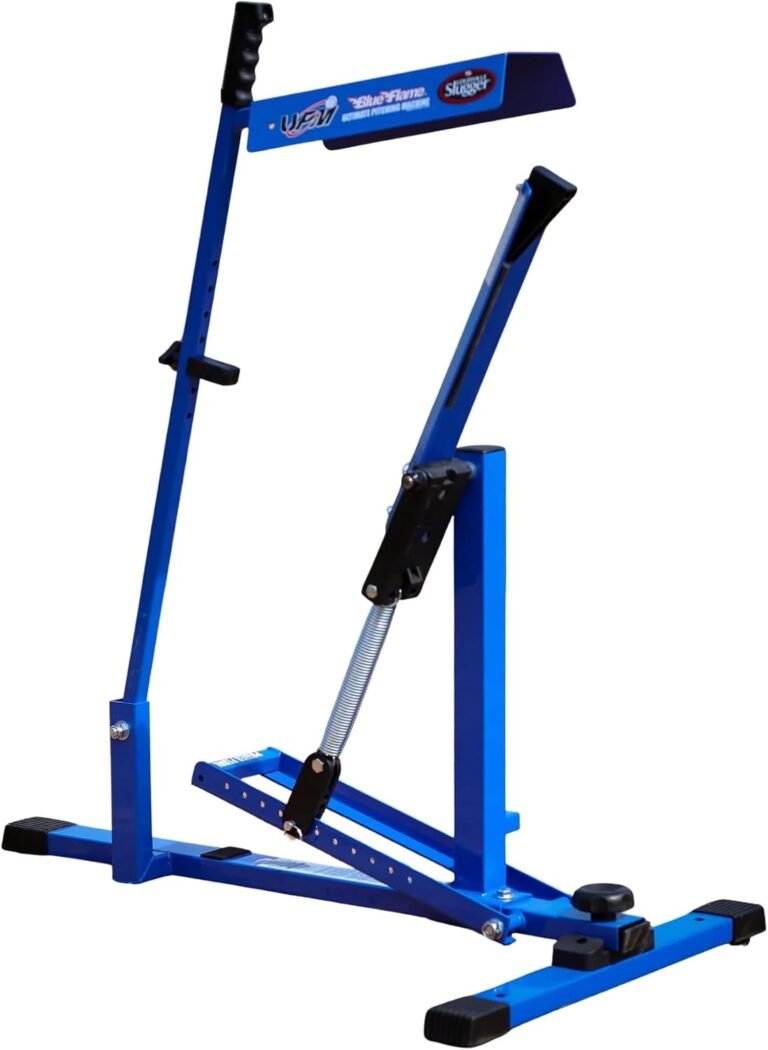
The Louisville Slugger Blue Flame is a classic manual machine that throws almost any ball – from hard baseballs to plastic and even soccer balls. You get speeds from 18 to 45 MPH on levels, making it suitable for youth to adults. It’s extremely accurate for strikes, grounders, and fly balls, and it’s approved by Babe Ruth and Pony leagues.
Because it’s manual, you’ll need to load each ball and use your foot to push the lever – it’s a workout for sure. But the lack of electricity means you can use it anywhere. If you want a dependable, versatile training tool that lasts for years, this is your best bet. Just be prepared for a physical workout during extended sessions.
Pros
- Versatile ball use
- Manual, simple design
- High accuracy
Cons
- Manual operation
- Takes practice to master
- Not electronic
Specifications
#2. Heater Base Hit
The Heater Sports Base Hit gives you real baseballs up to 45 MPH from a compact, lightweight frame. With the 12-ball auto feeder, you’ll get hands-free practice sessions every 8 seconds, ideal for focused batting and fielding drills. Its adjustable pitching head also handles grounders and pop flies, making it a versatile training partner for all skill levels.
You’ll appreciate the portability at just 15 pounds, but keep in mind it requires an outlet and works best with Heater’s dimpled balls to avoid jams. If you have a power source nearby and want a machine that grows with your training, this is a solid pick. Skip it if you need fully battery-powered operation or plan to use regulation balls exclusively.
Pros
- Auto ball feeder
- Adjustable pitch types
- Portable design
Cons
- No battery, needs power
- Dimpled balls recommended
- Can be finicky with jams
Specifications
#3. Furlihong 6902BHA
The Furlihong 6902BHA is a versatile toss machine with a rechargeable battery, freeing you from wall outlets. You can adjust the toss height from 1.2m to 1.7m for baseball and lower for softball, making it suitable for different drills. With four speed settings and consistent 6-second tosses, you get solid practice repetition.
You’ll need to purchase balls separately – that’s a slight drawback. The battery maintains a long life, but expect to replace it after several seasons. If you want a portable, battery-powered toss machine for field or backyard, this is a strong choice. It’s particularly good for coaches who move between stations.
Pros
- Cordless mobility
- Adjustable height
- Speed control
Cons
- Balls not included
- Battery could need replacement
- Limited to toss-style
Specifications
#4. Franklin MLB
Franklin Sports MLB machine is a kid-friendly choice that makes practice fun and engaging. With automatic pitches every 7 seconds, your young slugger gets steady reps without needing a pitcher. The flashing red light indicator helps them time their swing, while the adjustable angles allow you to vary the pitch location.
You’ll need to use the included AERO-STRIKE plastic balls and ideally a plastic bat to avoid damage. While it’s perfect for beginners age 3 and up, serious players might outgrow it quickly. If you’re looking for a backyard introduction to hitting, this is a fantastic option, but don’t expect game-speed pitches.
Pros
- Great for young players
- Automatic pitching
- Backyard-friendly
Cons
- Plastic bat required
- Only 6 balls included
- Not for regulation balls
Specifications
#5. Furlihong 3801BH
The Furlihong 3801BH offers smart features at an entry-level price. With adjustable wheels, you can set the pitch speed and angle to practice fastballs, curves, and sliders. It runs on 4 D batteries or the included AC adapter, giving you flexibility for field or garage training.
You’ll need to use Furlihong’s special 1 oz dimpled balls – regulation baseballs won’t work. That’s a trade-off for safety and bat protection. If you’re just starting out and want a machine to build hand-eye coordination, this is a great option. Advanced players might find the 30 MPH max limiting.
Pros
- Speed and angle adjust
- Battery or AC power
- Great for beginners
Cons
- Max speed 30 MPH
- Not for regular balls
- Batteries not included
Specifications
#6. SunwyxTek T Ball
This SunwyxTek machine is perfect for little sluggers aged 3 to 8. It automatically pops a ball every 7 seconds, letting kids practice hitting without needing a pitcher. The set includes 8 PP balls and a collapsible bat, making it a complete package right out of the box.
You’ll need to supply 4 AA batteries, but that’s a minor hassle. The balls are lightweight plastic, so they’re safe for indoor use. If you have a toddler or young child who’s just starting baseball, this is an excellent gift. However, more advanced players will quickly outgrow its capabilities.
Pros
- Batteries not included
- Collapsible bat
- Kid-friendly design
Cons
- Requires 4 AA batteries
- PP balls are very light
- Not for advanced use
Specifications
#7. Furlihong 898BH
The Furlihong 898BH is a no-fuss mechanical toss machine that doesn’t need batteries or electricity. Step on the paddle, wait 6 seconds, and it pops the ball up for you – simple and reliable. With three adjustable angles, you can vary the toss height to suit different skill levels.
While it’s great for beginners and backyard use, the toss is limited to 5 feet high, so it won’t simulate real pitching speeds. The mechanical action also requires a firm step each time, which might feel less polished than electric models. If you want a durable, power-free option for basic hand-eye coordination, this is a smart pick. Just don’t expect advanced features.
Pros
- Mechanical durability
- Works anywhere
- Easy setup
Cons
- Manual pedal operation
- Max 5 feet toss
- No speed adjustment
Specifications
The Real Scoop on Buying an Automatic Baseball Pitching Machine
A pitching machine is a serious investment in your swing, your kid’s development, or your team’s practice time. It’s not a grab-and-go purchase — the difference between a frustrating paperweight and a reliable practice partner comes down to a handful of decisions you make before you click “buy.”
The Nuts and Bolts That Actually Matter
Wheel configuration. Two-wheel machines are the standard for most hitters — they’re simpler, lighter, and easier to adjust for speed and spin. Three-wheel models offer more precise curveball and slider movement, but they cost more and take longer to dial in. Think about who’s swinging and what pitches they need to see.
Speed range and adjustability. Look for a machine that can grow with the hitter. A unit that tops out at 60 mph might be fine for a 10-year-old, but it’ll be useless in two years. Conversely, a machine that starts at 40 mph is frustrating for younger kids. A wide, smooth speed dial matters more than a single top-end number.
Ball capacity and feeding system. Gravity-fed hoppers are simple and reliable, but they can jam with worn or misshapen balls. Multi-ball rotary feeders are smoother but add moving parts that can break. If you’re running batting practice for a whole team, capacity matters — you don’t want to stop every five minutes to reload.
Portability and setup. These machines are heavy. Check the wheel quality, the frame’s foldability, and whether it fits in your car trunk. If you’re hauling it to a field every weekend, a 50-pound difference is huge. Also look at how quickly you can level it on uneven ground — a machine that rocks during delivery is a safety hazard.
Durability of the throwing wheels. The wheels are the heart of the machine. Look for models with replaceable tires and a reputation for holding up under heavy use. Cheap wheels wear out fast, and replacement costs add up quickly.
Sticking to your budget. The sweet spot for most families is the mid-range — you get solid construction, decent speed range, and a hopper that doesn’t jam. Bottom-tier machines often feel like toys, and top-tier models are overkill unless you’re coaching a high school team or older.
Traps That Trip Up First-Time Buyers
- Ignoring ball type. Some machines only feed dimpled plastic balls, which fly differently than real baseballs. If you want to practice with actual leather balls, make sure the machine handles them without jamming or tearing them up.
- Buying for the wrong arm angle. Most machines throw over-the-top fastballs, but if your hitter struggles against sidearm pitchers or needs to see more two-seam movement, you’ll need a machine with adjustable pitch angle — and that’s a feature you can’t add later.
- Skipping the warranty. These machines take a beating. A one-year warranty on a $700 purchase isn’t generous — it’s the bare minimum. Look for at least two years on the motor and frame, and check what the warranty actually covers before you assume you’re protected.
Locking In Your Perfect Automatic Pitching Machine
You’ve got the breakdown. The Louisville Slugger Blue Flame remains the top choice for serious hitters who want real velocity and durability. For a balanced, all-around option that won’t break the bank, the Heater Sports Base Hit delivers reliability with its automatic feeder. Parents of young beginners should lean toward the Franklin Sports MLB or the T-Ball Set for Kids — both are perfect for building confidence at the plate. The Furlihong models shine as budget-friendly, battery-powered alternatives for casual backyard practice.
No matter your skill level, each pick here is a solid investment under typical price points. Check the buttons above to confirm today’s best deal before stock changes — your reps start now.
Final 3 Picks: All-Ball, Versatility, and Rechargeable
Ready to decide? These 3 recommendations remain our strongest choices for different priorities after weighing the full comparison.
Louisville Slugger
- Throws any ball type
- Speeds up to 45 MPH
- No electricity needed