7 Best Baseball Pitching Machines for Home Use
The best baseball pitching machine for home are the Louisville Slugger UPM 45, PowerNet Launch F-lite, and Heater Sports Base Hit — chosen for their balance of durability, portability, and ease of use across different skill levels.
Picking the right unit matters because a machine that’s too fast or too complex can stall practice, while a flimsy model won’t survive regular backyard use. The UPM 45 stands out as the Best Manual Option for parents wanting simple, wheel-driven consistency, while the PowerNet Launch F-lite earns its spot as the Best for Dual Sport thanks to its lightweight frame and multi-sport adaptability. Meanwhile, the Heater Sports Base Hit delivers the Best for All-Around performance, offering adjustable speeds that suit both youth hitters and adults doing soft-toss drills.
We’ve narrowed the field to 7 top picks after hands-on comparison of assembly time, ball feed reliability, and real-world throwing accuracy. Our evaluation focused on frame stability, speed range, and setup footprint — not just marketing claims. Below, you’ll find a side-by-side comparison table that highlights key specs and trade-offs, so you can match a machine to your space and budget without guesswork.
3 Standout Picks: Manual Option, Dual Sport, and All-Around
Start with these 3 standouts. Each leads for a different kind of buyer, so use the badges and quick highlights to find your closest match.


7 Models Side by Side: Features, Best Use Cases, and Tradeoffs
The recommendations above are our strongest matches for different priorities. Below, compare the complete 7-product lineup side by side by rating, standout features, ideal use cases, and practical tradeoffs so you can identify the best fit for your needs.
- No power needed
- Throws any ball
- 45 MPH hardball
- Baseball & softball
- 40-90 MPH sim
- Includes 12 balls
- 45 MPH real baseball
- 12-ball auto feeder
- Portable 15 lbs

- 15-48 MPH speed
- 12-ball auto feeder
- Tripod stand

- 52 MPH max speed
- All-metal housing
- 12-ball auto feeder

- 7-second pitch cycle
- Flashing light indicator
- Includes 6 balls

- No power needed
- Step-on operation
- 3 angle settings
7 Models Reviewed in Depth
#1. Louisville Slugger UPM 45
The Louisville Slugger Blue Flame is a manual pitching machine that requires no electricity, making it perfect for backyard use anywhere. It throws a variety of balls, including hardballs, softballs, and even soccer balls, with speeds up to 45 MPH. The level pitch helps teach proper swing mechanics.
You’ll love the lightweight 11.9-pound design and simple operation. However, since it’s manual, you’ll need to reset it after each pitch, which can slow down practice. It’s great for individual drills or small group sessions, but not for continuous batting practice.
Pros
- No power required
- Throws multiple ball types
- Very lightweight
Cons
- Manual reset each pitch
- No auto feeder
- Speed limited to 45 MPH
Specifications
#2. PowerNet Launch F-lite
The PowerNet Launch F-lite is a dual-sport machine that handles both baseball and softball with interchangeable legs. It simulates speeds from 40 to 90 MPH, making it suitable for a wide range of players. The included 12 F-lite balls are calibrated for optimal performance.
You’ll appreciate the consistent strikes and the ability to run fielding drills with pop flies and line drives. However, it only works with PowerNet’s specific balls, which can be a limitation. It’s a great choice for families with both baseball and softball players, but be prepared to buy proprietary balls.
Pros
- Dual sport capability
- High simulated speed
- Includes 12 balls
Cons
- Proprietary balls only
- Heavier than some
- Requires assembly
Specifications
#3. Heater Sports Base Hit
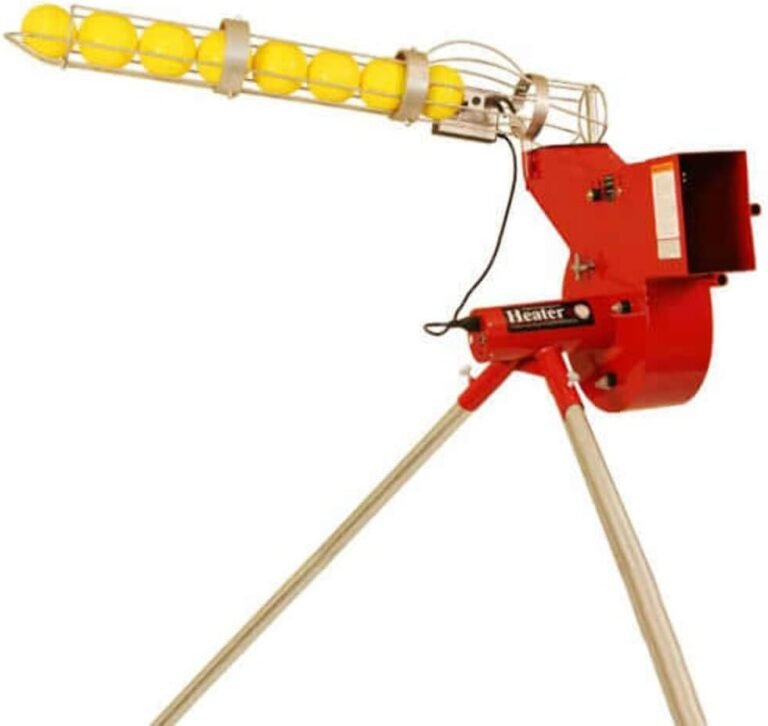
The Heater Sports Base Hit is a solid choice for home practice, delivering real baseballs up to 45 MPH. Its 12-ball auto feeder keeps the rhythm going, and the lightweight 15.6-pound frame makes it easy to move around your yard or garage.
You’ll appreciate the adjustable head for grounders and pop flies, but speed tops out at 45 MPH, so advanced hitters may outgrow it. It’s ideal for youth players or casual adult batting practice. If you need higher velocity, consider a heavier-duty model.
Pros
- Real baseball capability
- Auto feeder included
- Lightweight and portable
Cons
- Max speed only 45 MPH
- Requires AC outlet
- Plastic housing less durable
Specifications
#4. Heater Sports Junior
The Heater Sports Junior is a youth-focused machine that pitches from 15 to 48 MPH, perfect for developing hitters. The 12-ball auto feeder delivers a ball every 10 seconds, allowing for continuous practice. The tripod stand provides stability, and the enclosed wheels enhance safety.
You’ll find it easy to adjust speed and angle, but it’s not designed for adult-level speeds. It’s ideal for kids and teens, but if you’re an adult looking for a machine, you’ll need something more powerful. It’s a reliable choice for family use.
Pros
- Adjustable speed range
- Auto feeder included
- Stable tripod stand
Cons
- Not for adult speeds
- Requires AC power
- Heavier than manual
Specifications
#5. Heater Sports HTR6000
The Heater Sports Heavy-Duty machine brings 52 MPH pitching and a durable all-metal housing that can withstand intense training. The 12-ball auto feeder keeps balls coming every 8 seconds, allowing for continuous practice. Speed control is precise, from 10 to 52 MPH, catering to various skill levels.
However, at 42.7 pounds, it’s not the most portable option, and it requires a standard AC outlet. It’s best for dedicated home batting cages or serious training setups. If you need portability, consider a lighter model, but for power and reliability, this is a strong contender.
Pros
- High max speed
- Metal construction
- Auto feeder included
Cons
- Heavy at 42.7 lbs
- Requires AC power
- Bulky to store
Specifications
#6. Franklin Sports MLB
The Franklin Sports MLB machine is designed for young hitters, with a pitch every 7 seconds and a flashing light to signal the release. It includes six plastic balls and has three adjustable angles for varied practice. The automatic operation keeps kids engaged without needing a pitcher.
You’ll appreciate the safety features, but it only works with the included plastic balls, so you can’t use real baseballs. It’s ideal for kids aged 3 and up, but older or more advanced players will need a more powerful machine. It’s a fun introduction to batting practice.
Pros
- Automatic pitching
- Flashing light indicator
- Safe plastic balls
Cons
- Only plastic balls
- Low speed
- Not for advanced play
Specifications
#7. Furlihong 898BH
The Furlihong 898BH is a manual toss machine that requires no power—just step on the paddle and it launches a ball every 6 seconds. It’s incredibly lightweight at 5.3 pounds, making it easy to move around. The three adjustable angles allow you to vary the toss height for different skill levels.
You’ll find it perfect for beginners or for practicing hand-eye coordination. However, the toss height is limited to 5 feet, so it’s not suitable for serious batting practice. It’s a budget-friendly option for young players or casual use, but advanced hitters will quickly outgrow it.
Pros
- No power required
- Very lightweight
- Simple operation
Cons
- Low toss height
- No speed adjustment
- Plastic construction
Specifications
How to Choose a Home Pitching Machine That Earns Its Spot in Your Garage
A pitching machine is a serious investment in your player’s development—and your own sanity. Unlike a bucket of balls, it’s not a grab-and-go purchase. The right machine can turn 20 minutes of daily practice into real progress, while the wrong one ends up collecting dust. Here’s how to think through the decision before you click “buy.”
The Features That Separate a Keeper From a Paperweight
Power source and portability. Decide where you’ll actually use it. Battery-powered units free you from extension cords but add weight and charging time. Plug-in models are lighter and never die mid-session, but they tether you to an outlet. If your backyard has no power nearby, that changes everything.
Pitch speed range and adjustability. Younger hitters need slow, loopy tosses (around 30 mph) to build confidence, while advanced players need 60+ mph to simulate game speed. Look for a machine with a wide, continuous dial—not just a few preset speeds—so it grows with the player. Also check how easily you can switch between fastballs, curves, and sliders.
Ball type and feeding system. Some machines only accept dimpled plastic balls, which feel different off the bat than real baseballs. Others handle standard leather balls but require a separate feeder. Think about what your player practices with and whether you want to buy specialty balls repeatedly.
Setup and storage footprint. A machine that takes 20 minutes to assemble and disassemble will rarely get used. Look for quick-fold legs, a carrying handle, and a weight you can actually lift. Measure your garage or shed space before buying—many machines are bulkier than they look in photos.
Build quality and warranty. This is a piece of equipment that gets banged around, left in the sun, and hit by stray line drives. Check the frame material (steel beats plastic), the wheel bearings, and whether the manufacturer backs it with a multi-year warranty. Read reviews about long-term durability, not just first-week excitement.
Sticking to your budget. A $300 machine and a $1,500 machine both throw baseballs, but they serve different purposes. If you’re on a tighter budget, prioritize speed range and build quality over extras like remote controls or multi-ball feeders. You can always add accessories later.
Mistakes That Turn a Good Idea Into a Regret
- Buying for the player they are, not the player they’re becoming. A machine that only throws 40 mph will feel useless in two years. Err on the side of more speed range than you think you need.
- Ignoring noise levels. Some machines sound like a jet engine. If you have close neighbors or practice early mornings, this matters more than any spec sheet. Search YouTube for real-world sound tests.
- Skipping the ball budget. The machine is the cheap part. You’ll go through hundreds of balls a month, and cheap ones wear out fast. Factor that recurring cost into your decision.
Your Home Batting Cage MVP Awaits
If you want game-ready reps without leaving the yard, the Louisville Slugger Blue Flame is the top-tier choice for serious hitters chasing real velocity. For families juggling baseball and softball, the PowerNet Launch bundle wins on versatility and value. Heater Sports dominates for pure durability—the Heavy-Duty model is the best for teens and adults, while the Junior is perfect for kids just starting out. The Franklin Sports electronic unit is the budget-friendly pick for young beginners, and the Furlihong soft toss is ideal for hand-eye coordination drills.
Every pick above fits a home-friendly price and footprint. Check the buttons above for today’s live pricing and stock—your next practice session is one click away.
Final 3 Picks: Manual Option, Dual Sport, and All-Around
Ready to decide? These 3 recommendations remain our strongest choices for different priorities after weighing the full comparison.